Mediterranean Diet for Beginners: What It Is and How to Start
As an Amazon Associate, this website earns from qualifying purchases.
What the pattern actually is, where the sources disagree, the five swaps that do most of the work, a specific day one, your first shop, and what to change in week two.
On this page 10
Mediterranean eating is a pattern, not a plan you start on a Monday. For a beginner the whole thing comes down to five defaults: the fat you cook in, the grain you reach for, whether a legume turns up, whether fish turns up, and whether vegetables are on the plate at every meal. Change those five and you are eating the pattern, using food you already know how to cook.
The American Heart Association describes the pattern as one built on minimally processed plant foods, with olive oil as the primary fat, fish and poultry eaten more often than red meat, low to moderate amounts of dairy and eggs, and fruit as the usual dessert. Nothing on that list is exotic and nothing on it is banned. What follows is how to do it this week.
What the pattern actually is, and where the sources disagree
There is no single Mediterranean diet. That is the most useful sentence anyone can give you, and most pages answering the question skip straight past it. What is described today as "the Mediterranean diet" is a modern construct: a pattern assembled in the twentieth century from observations of how people ate in a few places around one sea — the modern version traces to Ancel and Margaret Keys, whose observations date from the late 1950s and 1960s — then standardised into pyramids and food lists. The Wikipedia overview is clear that the diet varies by country, culture and era, and the NIH's StatPearls overview is where the clinical literature's version of the summary sits.
That does not make it made up. It makes it a generalisation, and knowing that changes how you read every number attached to it, including the ones on this site.
Underneath the disagreement there is a stable core, and it is best expressed as frequency rather than as rules. The Oldways Mediterranean Diet Pyramid is the clearest version of it.
| Tier | How often | What sits there |
|---|---|---|
| Base | Every meal | Fruit, vegetables, whole grains, legumes, beans, nuts, seeds, healthy oils, herbs and spices |
| Second | Often, at least twice a week | Fish and seafood |
| Third | Moderate portions, daily to weekly | Poultry, eggs, cheese, yogurt |
| Top | Less often | Meats and sweets |
Oldways names water as the recommended drink, and puts two lifestyle instructions on the pyramid itself: be physically active, and enjoy meals with other people. They sit there beside the food tiers rather than as a footnote.
Notice what the tiers do. They do not remove foods. They set how often each one appears. The food list is the same tiers written out item by item.
Where the sources genuinely differ
Alcohol is the clearest case, because five reputable sources describe it five different ways.
| Source | What it says about alcohol |
|---|---|
| American Heart Association | Wine may be consumed in low to moderate amounts, usually with meals |
| Harvard Nutrition Source | Water as the main daily beverage, with moderate wine with meals — about one to two glasses a day for men and one for women |
| Oldways | Wine "in moderation", with no quantity given; water is the recommended drink |
| MedlinePlus (NIH) | Notes plainly that some people should not drink alcohol |
| Mayo Clinic Diet | Its overview of the core principles does not mention alcohol at all |
One source gives a number, one a range, one a word, one a caution, and one declines to raise the subject. There is no settled figure hiding behind that spread. The only defensible summary is the historical one: traditional Mediterranean eating often included wine with meals, authorities differ on whether and how much to recommend, and several are explicit that a person who does not drink should not start.
Alcohol is the sharpest example but not the only one. MedlinePlus describes eggs as a small number of times a week or none, while Oldways puts them in the moderate daily-to-weekly tier. Harvard and Oldways say fish at least twice a week; the Mayo Clinic Diet says two to three times. Mayo gives a daily olive-oil quantity and the others give none. None of those sources is wrong; they are summarising an inherently loose pattern for different audiences.
One thing they all agree on and readers often miss: it is the whole pattern that matters, not any one food. Harvard's Nutrition Source is explicit about that. Olive oil is not a magic ingredient; it is the fat that makes vegetables and legumes worth eating every day, which is why chasing one ingredient is the most common way to get this wrong.
The five swaps that do most of the work
1. Change the fat you cook in
This is the single change that shifts the most meals at once, because almost everything you cook passes through it. Butter and neutral seed oils step back; extra-virgin olive oil becomes the default for frying, roasting, dressing and finishing.
Harvard's Nutrition Source describes olive oil as replacing butter as the primary added fat in this pattern, and notes that the high total fat intake which comes with it is not counted against the pattern. The Mayo Clinic Diet puts a number on it — 1 to 2 tablespoons of extra-virgin olive oil a day — which is Mayo's figure, not a universal one.
In practice: buy one bottle you are happy to pour freely from and keep it next to the hob. You do not need a separate expensive finishing oil yet. If you want a starting point, a bottle you will actually use every day beats a small tin you save for special occasions.
2. Change the grain you default to
Not "no carbs". A different carb, more of the time. Whole-grain bread instead of white as the house loaf. Brown rice, barley, farro or bulgur as the side you reach for without thinking. Oats for breakfast. Pasta stays, and whole-wheat pasta is worth a try, but if you dislike it, ordinary pasta with a pile of vegetables and beans stirred through is still far closer to the pattern than a plain white-rice side.
Oldways puts whole grains on the base tier of its pyramid, alongside fruit, vegetables, legumes, beans, nuts, seeds, healthy oils, herbs and spices — the tier meant to appear at every meal.
3. Add one legume, deliberately
Legumes are the swap beginners skip, and then they wonder why the food feels thin. Chickpeas, white beans, lentils, butter beans. A tin is thirty seconds of work.
Start with one legume meal a week and let it grow. Stir a tin of cannellini beans into pasta with garlic and greens. Warm chickpeas in olive oil with tomatoes and spinach. Put lentils under a piece of roast chicken. Once you have three of these you have a rotation.
4. Fish or seafood, twice a week
Harvard's Nutrition Source describes fish and seafood at least twice weekly, and Oldways uses the same "often, at least twice a week" framing on its pyramid. The Mayo Clinic Diet says two to three times a week. Take twice a week as the floor everyone agrees on.
This does not require a fishmonger. Tinned sardines on toast with lemon is a Mediterranean meal. So is frozen white fish roasted on a tray with potatoes. See mediterranean diet mistakes for why the fresh-fish assumption stops more people than anything else on this page.
5. Vegetables at every meal
Not a side salad as an afterthought. Vegetables as a component of the plate: roasted, dressed in oil, or raw with lemon. The easiest version is one big tray of roasted vegetables early in the week that you then eat from all week — under eggs, next to fish, folded through grains, crushed into a rough sauce for pasta.
What does not change
This is the part beginners get wrong, and it is the reason the pattern lasts.
- Bread stays. It moves toward whole grain, and it usually shares the plate with something else.
- Pasta stays. It becomes a vehicle for beans, greens and oil rather than the entire meal.
- Cheese stays. Oldways puts cheese and yogurt in the moderate daily-to-weekly tier. Feta on a salad, parmesan on pasta, yogurt at breakfast.
- Eggs stay. Also moderate. MedlinePlus describes eggs in this pattern as a small number of times a week or none at all, which is one of the places sources genuinely differ.
- Red meat stays, less often. Harvard's Nutrition Source describes red meat a few times a month; the Mayo Clinic Diet says perhaps once a week or less. Either way it becomes a smaller part of the plate rather than an absence.
- Coffee stays. Nobody is asking you to give it up.
None of this is an elimination diet. Foods move down the frequency ladder rather than off the list, which is what foods to limit actually means in practice.
Day one, specifically
Start with one change, not twelve. The people who make this stick almost never switch over in a weekend. Here is a first day that takes one shop and one dinner.
- Buy a bottle of extra-virgin olive oil and put it beside the hob. Not in the cupboard. Visible, and within reach of the pan.
- Buy four tins: chickpeas, cannellini beans, chopped tomatoes, sardines. That is your floor. On any evening you have nothing planned, one of those four becomes dinner.
- Buy the breakfast you are going to repeat — plain yogurt and fruit, or oats, or eggs and a loaf of whole-grain bread. One breakfast, bought for the whole week.
- Cook the chickpea pan tonight. It is the first of the three dinners below, it takes twenty minutes, and it is the meal most likely to make you do this again tomorrow.
That is day one. No plan, no tracking, no new equipment.
Your first shop
You are buying a base, not a pantry. Everything below is ordinary supermarket stock.
| Section | Buy this | Why it earns the space |
|---|---|---|
| Oil and acid | Extra-virgin olive oil, lemons, red wine vinegar | The dressing for almost everything you will cook |
| Tins and jars | Chickpeas, cannellini beans, chopped tomatoes, sardines, olives | Dinner on the nights you did not plan dinner |
| Grains | Whole-grain bread, oats, brown rice or barley, pasta | The default side, changed once |
| Fresh | Onions, garlic, tomatoes, spinach or chard, cucumber, whichever fruit is cheap | Volume, and the vegetables at every meal |
| Fridge | Plain yogurt, feta, eggs | Breakfast, and the small salty finish |
| Freezer | White fish fillets, frozen peas or spinach | Fish twice a week without a special trip |
That list is deliberately short. The full food and grocery list is there when you want to widen it, and pantry staples covers what to keep permanently. Do not buy the long version yet.
Your first three dinners
Cook these three in your first week. They use the shop above and nothing else.
Chickpeas with tomato and spinach. Soften a sliced onion and three cloves of garlic in a generous pour of olive oil. Add a tin of chopped tomatoes, a drained tin of chickpeas, salt and pepper. Simmer for fifteen minutes until it thickens and stops looking like soup. Stir in a large handful of spinach until it collapses. Finish with lemon and more oil. Eat it with bread. It is better the next day, which makes it the most useful thing in your first week.
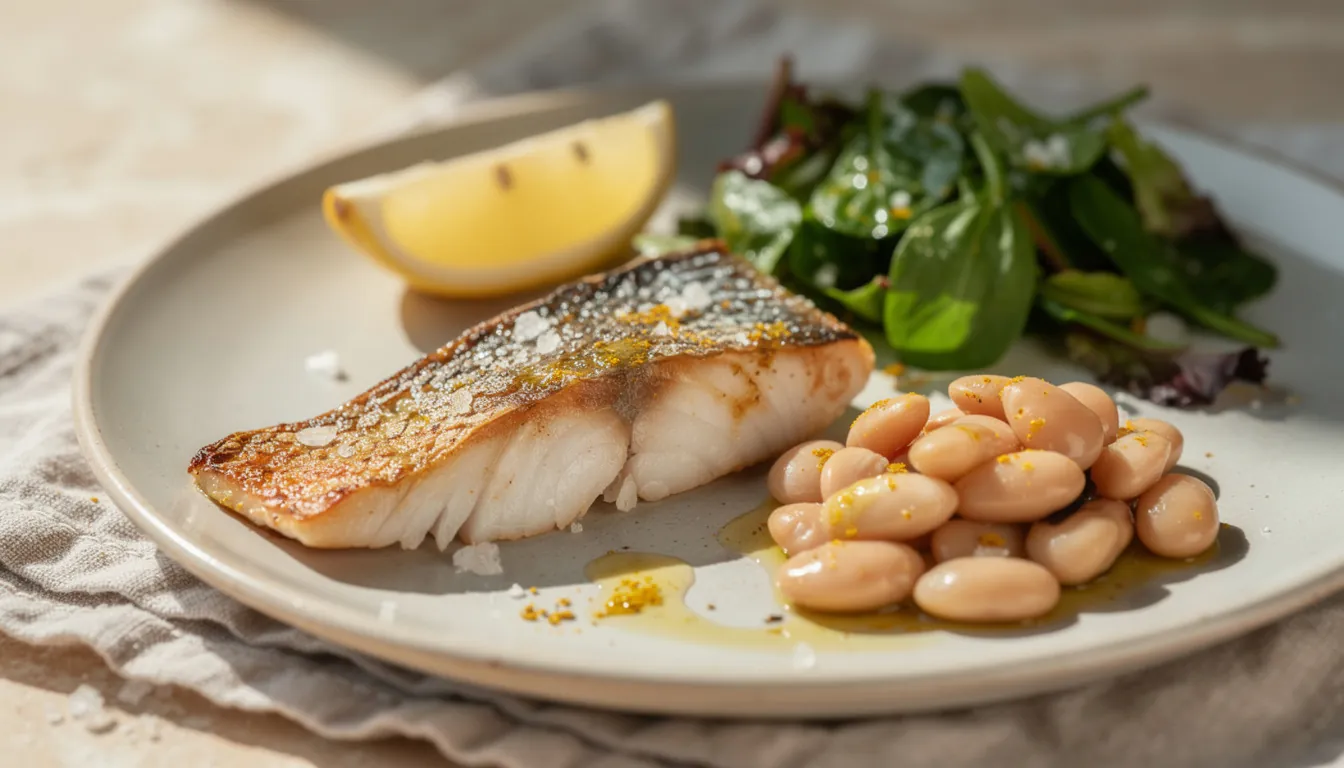
Sheet-pan fish with potatoes, lemon and olives. Halve small potatoes, toss them with olive oil and salt, roast at 200C for twenty-five minutes. Push them to one side of the tray, lay two fish fillets in the space with lemon slices, olives and cherry tomatoes, add more oil, and roast for another eight to ten minutes until the fish flakes. One tray, one wash-up, and it works with frozen fillets thawed in the fridge overnight.
Pasta with white beans and greens. Cook pasta. While it boils, warm sliced garlic slowly in a lot of olive oil — slowly, so it goes gold rather than brown — then add a drained tin of cannellini beans and a bunch of chopped greens, and a ladle of the pasta water. Toss the drained pasta through it with parmesan and plenty of black pepper. This is the meal that convinces people the pattern is not a punishment.
What to change in week two
Do not add everything at once. Week two is three moves:
- Make fish happen twice, and let one of the two be tinned. That is the frequency Harvard and Oldways both describe, and tinned is how most people hit it.
- Roast one big tray of vegetables on the first evening you are home, and build two later meals from it.
- Make breakfast repeatable — yogurt with fruit and nuts, or oats, or eggs with tomatoes on toast. Deciding breakfast once removes a daily decision. Breakfast ideas has more of them, and snacks covers the gap at four in the afternoon.
After that, the useful next step is structure rather than more rules. A meal plan turns the swaps into a week you do not have to think about, the 7-day plan is the shortest version of that, and meal prep is how people keep it going past a fortnight. If cost is the constraint, on a budget is the honest version — tins, frozen fish and dried legumes carry it.
What not to bother with at the start
Three things waste the enthusiasm you only have once.
Do not buy speciality ingredients. Not the aged vinegar, not the four kinds of olive, not the imported tinned fish with the nice label. Buy a working bottle of oil and four tins. The food list is deliberately arranged by frequency rather than by shelf; pantry staples is for month two.
Do not count anything. Not calories, not macros, not servings. This site sets no calorie targets, and the frequencies in this pattern are described in weeks, not in numbers per day. If you want a structure to follow instead of arithmetic, that is what a meal plan is for.
Do not throw food away. Nothing here is banned. Bread, pasta, cheese, eggs and red meat all stay in the pattern — they move down the frequency ladder, as foods to limit explains. Eat what you own and change what you buy next.
When you fall off
You will. Some week there will be three takeaways, a birthday, and a Tuesday where dinner was toast standing up. None of that matters much, because this pattern is measured in months.
What actually breaks it is not the gap. It is deciding the gap means you have failed, and then waiting for a Monday.
So restart at the next meal. Not tomorrow, not next week. If the fridge is empty, the chickpea pan needs two tins and an onion. If you have not shopped, sardines on toast is a meal that meets the fish target. If you have lost the thread entirely, do only the first item on day one — put the oil beside the hob and cook in it. One change is a start; a plan to be perfect is not.
Two other things help. Keep the four tins stocked as a permanent floor, so the worst version of your week still lands inside the pattern. And notice that this pattern is unusually forgiving of a bad day, because it has no forbidden foods to fall off from.
Where to go next
- Mediterranean diet meal plans — the swaps turned into a week you do not have to think about, including the 7-day plan and the printable version.
- The food list — every tier written out item by item, plus the aisle-by-aisle shop.
- Mediterranean diet mistakes — the seven things that stall beginners, and what to do instead of each.
- Meal prep — how people keep this going past a fortnight, with breakfasts, lunches, dinners and snacks.
- Our kit page — the small number of things worth owning, including the tins and jars that make a weeknight dinner possible.
One last thing. This site describes an eating pattern and how to cook it. It gives no medical advice and it has no dietitian on staff. If you have a diagnosed condition, are pregnant, take medication, or have allergies, take this to a qualified professional before changing how you eat. Our medical disclaimer says exactly what that means.
Get the free 7-day plan and shopping list
Questions people ask
What is the Mediterranean diet, exactly?
A frequency pattern rather than a rulebook. Fruit, vegetables, whole grains, legumes, nuts and olive oil at most meals; fish and seafood often, at least twice a week; poultry, eggs, cheese and yogurt in moderate portions; meats and sweets less often. There is no single Mediterranean diet — the modern version is a twentieth-century generalisation about how people ate in several different countries.
How do I start the Mediterranean diet?
With one change, not twelve. Put a bottle of extra-virgin olive oil beside the hob and cook in it. Buy four tins — chickpeas, cannellini beans, chopped tomatoes, sardines — so any unplanned evening still has a dinner in it. Then add one legume meal, and get fish onto the week twice. Two weeks is enough to move every default.
Do I have to give up bread and pasta?
No. Whole grains sit on the base tier of the Oldways pyramid, and bread and pasta appear across the Mediterranean. What usually changes is the default: more whole-grain versions, more often served alongside vegetables and legumes than as the whole plate.
How much olive oil should I use?
There is no single agreed number. The Mayo Clinic Diet suggests 1 to 2 tablespoons of extra-virgin olive oil a day, which is Mayo's figure rather than a universal rule. Harvard's Nutrition Source describes olive oil as replacing butter as the main added fat without attaching a quantity.
How often should I eat fish?
Harvard's Nutrition Source and Oldways both describe fish and seafood at least twice a week. The Mayo Clinic Diet says two to three times a week. Tinned sardines, tinned tuna and frozen fillets all count.
Do I need to count calories?
This site sets no calorie targets. Harvard's Nutrition Source does note that without attention to portions the pattern can carry more calories than someone intends, largely because of the oil and the nuts.
Is this suitable if I have a diagnosed condition?
Ask a qualified professional who knows your history. Anything involving a diagnosed condition, pregnancy, medication or allergies belongs with a clinician rather than a website. Our medical disclaimer page sets out what this site is and is not.
Everything in this section
- Mediterranean Diet Mistakes: Seven Honest Corrections
Too much oil, no legumes, a shelf of ingredients you never cook, and fish you never buy. The seven ways this goes wrong, and what to do instead of each.
This page is general information about food and cooking, not medical or dietetic advice. Read the full disclaimer.