Mediterranean Diet Meal Plan: A Full Week, Built Simply
This page contains an affiliate link; we may earn a commission if you buy through it.
A full Mediterranean diet meal plan: a sample week of breakfasts, lunches and dinners, the frequencies the major sources give, and how to build your own.
On this page 8
A Mediterranean meal plan is less a stack of recipes than a shape. Vegetables, beans, whole grains, fruit, nuts and olive oil carry most of the plate. Fish and seafood turn up often, poultry, eggs, cheese and yogurt in moderate amounts, red meat rarely, and water is the everyday drink. Below is a full sample week you can shop for and cook this weekend, then the method underneath it, so that by week two you are building your own instead of following anyone else's. If you batch-prep that week, the glass meal prep container guide compares storage options without prescribing a health outcome.
What the pattern actually asks for
The major sources agree on the shape and differ slightly on the numbers. It is worth seeing whose number is whose rather than taking any single figure as the rule.
| Food | How often | Who describes it that way |
|---|---|---|
| Vegetables, fruit, whole grains, legumes, nuts, seeds, herbs | The base of every meal | Oldways |
| Olive oil | The primary fat, in place of butter | American Heart Association, Harvard Nutrition Source |
| Fish and seafood | At least twice a week | Harvard Nutrition Source, Oldways |
| Fish and seafood | Two to three times a week | Mayo Clinic Diet |
| Extra-virgin olive oil | One to two tablespoons a day | Mayo Clinic Diet |
| Poultry, eggs, cheese, yogurt | Moderate portions, daily to weekly | Oldways |
| Red meat | A few times a month | Harvard Nutrition Source |
| Red meat | Perhaps once a week or less | Mayo Clinic Diet |
| Fruit | The usual dessert | American Heart Association |
| Water | The recommended drink | Oldways |
Two things follow from that table. First, "at least twice a week" for fish is the floor everyone supports; the two-to-three framing is Mayo's own, not a universal standard. Second, Harvard makes a point worth holding on to: this is a whole pattern, not a list of individual foods to chase. Buying one bottle of good oil changes very little. Rearranging what sits at the middle of the plate changes everything.
The four things you cook
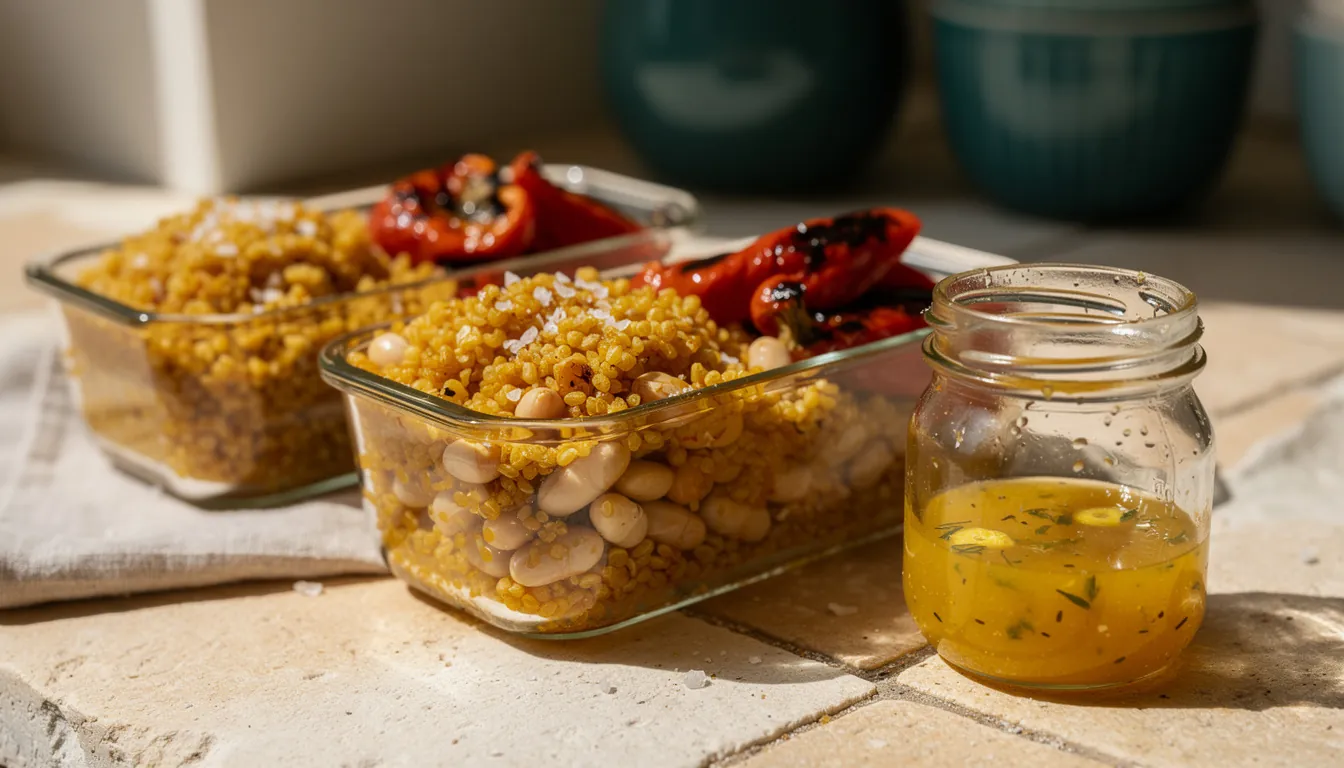
Here is the idea that makes a Mediterranean week possible on a Wednesday night. You do not cook seven dinners. You cook four components at the weekend and assemble from them all week.
A grain
A pot of bulgur, farro, brown rice or pearl barley. Cooked, cooled, kept in the fridge. It becomes a salad base on Tuesday, a bed for baked fish on Thursday, and the filling stretcher in stuffed vegetables on Saturday. Bulgur is the fastest of the four; it needs boiling water and twenty minutes of sitting.
A legume
A pot of lentils, or chickpeas, or white beans. Dried and cooked from scratch if you have the hour, tinned if you do not. Nobody can tell the difference once they are dressed while still warm with olive oil, lemon and salt. Legumes are what make a small meat portion feel like a choice rather than a loss.
A tray of vegetables
Whatever is cheap and in season, cut into similar-sized pieces, tossed with olive oil and salt, roasted hard until the edges catch. Peppers, onions, zucchini and tomatoes in summer; carrots, fennel, cauliflower and squash in winter. Cold from the fridge they go into salads, into pita, onto toast, or under an egg.
One sauce or dressing
A jar of lemon and olive oil dressing with garlic and oregano, or a yogurt sauce with lemon and mint, or a simple tomato sauce. One jar covers the week and is the single biggest difference between "leftovers again" and something that tastes deliberate.
With those four in the fridge, dinner is assembly plus one hot thing: fish under the grill, eggs in a pan, a piece of chicken, or nothing at all.
A full sample week
This is a real week, not a demonstration. Meals repeat on purpose and Sunday's roast is deliberately oversized so the following Monday cooks itself.
| Day | Breakfast | Lunch | Dinner |
|---|---|---|---|
| Monday | Oats soaked overnight in milk and yogurt with grated apple, cinnamon and walnuts | White bean and tuna salad: tinned cannellini, tinned tuna, red onion, parsley, lemon and olive oil over spinach, with bread | Sheet-pan chicken thighs with lemon, oregano, potatoes, red onion and peppers; cucumber and tomato salad |
| Tuesday | Wholegrain toast rubbed with a cut tomato and olive oil, plus a boiled egg | Leftover chicken shredded into pita with cucumber, yogurt, lemon and mint | Lentil soup: brown lentils, onion, carrot, celery, tinned tomatoes and bay, finished with olive oil and lemon; bread |
| Wednesday | Greek yogurt with orange segments, walnuts and a little honey | Leftover lentil soup with a tomato and feta salad, oregano over the top | Cod baked with cherry tomatoes, olives, capers and garlic; bulgur alongside; green beans |
| Thursday | The second jar of overnight oats, made Monday | Bulgur salad: leftover bulgur with chickpeas, cucumber, tomato, parsley, mint, lemon and crumbled feta | Spaghetti with tinned tomatoes, garlic, chilli flakes, tinned sardines, olives and parsley; green salad |
| Friday | Eggs scrambled with spinach and tomato on wholegrain toast | Leftover bulgur and chickpea salad with extra greens | Salmon roasted with fennel, red onion and orange slices; roast potatoes; broccoli with lemon |
| Saturday | Eggs baked in a tomato and pepper sauce, with bread to mop it | Mezze plate: hummus, olives, feta, tomatoes, cucumber, pita and any leftover roast vegetables | Eggplant halves baked with a tomato, onion and garlic filling and a little grated cheese; rice or bulgur; salad |
| Sunday | Yogurt with fruit and seeds | Leftover baked eggplant with a fried egg on top and bread | Roast chicken with lemon, garlic and potatoes; a large salad. Keep the leftover meat and the carcass |
Snacks sit outside the table on purpose: fruit, a small handful of almonds or walnuts, yogurt, olives, or vegetable sticks with hummus. The snack list has more, but those five cover almost everyone.
How the week hangs together
Read the table again and you will see only four real cooking sessions. Monday's traybake feeds Tuesday lunch. Tuesday's soup feeds Wednesday lunch. Wednesday's bulgur feeds Thursday and Friday lunch. Saturday's eggplant feeds Sunday lunch. Sunday's chicken feeds the Monday after. The middle of the week costs almost nothing in effort, which is exactly when good intentions usually collapse.
Fish appears four times across the week — tuna on Monday, cod on Wednesday, sardines on Thursday, salmon on Friday — which clears the twice-weekly floor Harvard and Oldways describe with room to spare. Red meat does not appear at all. That is not a rule against it; it is what "a few times a month" looks like in practice once you plan seven days at a time.
Build your own week in four steps
- Pick your fish nights first. Two at minimum. One tinned and cheap, one fresh if the budget allows. Everything else arranges itself around them.
- Give one night to legumes. Soup, stew, a large dressed bean salad, or pasta with chickpeas. This is the night that keeps the shopping affordable.
- Give one night to vegetables at the middle of the plate. Stuffed, roasted or baked in tomato — not a side dish moved to the middle, an actual main.
- Leave two nights unplanned. They fill themselves with leftovers, eggs, or toast and whatever is in the fridge. Planning them is how a plan starts to feel like a job.
That is the whole system. The meal prep guide covers the cooking order that gets the weekend session down to about ninety minutes, and the food and grocery list turns any week you build into a single shop.
Which plan length actually suits you
There are four versions of this plan on the site and they are not a ladder. Pick by how much structure you want to be handed, not by how committed you feel.
Seven days, fully specified. Every meal named, one aisle-ordered shopping list attached, nothing to decide. This is the right starting point for almost everyone, because the shopping list is the part that makes a plan survive contact with a Tuesday. It is also the shortest commitment that still teaches you the component system. The 7-day plan is that version.
Thirty days, as a rotation. Not thirty recipes — four weeks built from the same component set with the variables rotated, so week three costs no more effort than week one. This suits people who already cook and want a longer runway before they have to think again. The 30-day plan sets it out.
A printable page for the fridge door. The version that gets used most is often the one nobody has to open a browser for. The printable plan covers what is in the free download, who it suits and what it deliberately leaves out.
The budget version. When cost is the constraint the pattern does not change, the sourcing does: dried pulses instead of tinned, frozen fish and vegetables, cheaper cuts of grain, and seasonal produce rather than a fixed list. Eating this way on a budget is the honest version, and it is not a compromised one — tins and frozen goods are what make the fresh part sustainable in the first place.
The thing all four share is the shopping list. A plan without one is a wish, because the failure almost never happens at dinner — it happens on the evening you open the fridge and the components are not there. The food and grocery list is the general version for any week you build yourself, and pantry staples is the cupboard all of them run from.
Where people slip
The most common failure is using olive oil as an addition rather than a replacement. Harvard's framing is that it goes in instead of butter. Pouring it on top of the way you already cook misses the point entirely.
The second is quiet and worth naming: MedlinePlus notes that a lower dairy intake can mean less calcium in the day. If you are cutting back on milk and cheese, keep yogurt in the rotation and pay attention to other sources. That is a reason to be deliberate, not a reason to avoid the pattern.
The third is buying the aesthetic instead of the food — imported vinegars and pretty jars while the cart still holds the same ready meals. The foods to limit page is blunter about that, and the common mistakes page lists the rest.
If you have a diagnosed condition, are pregnant, take medication or manage allergies, get advice from someone who knows your history before you change how you eat. See our medical disclaimer.
Where to go next
- The 7-day plan — the same idea with a complete, aisle-ordered shopping list attached.
- The 30-day plan — four weeks built from a rotating component set, not thirty recipes.
- The printable PDF — what is in the free plan and who it suits.
- Eating this way on a budget — tinned, dried and frozen staples doing the heavy lifting.
- The full food list — what belongs in the cart, by category.
- Starting from scratch — what the pattern is, where the sources disagree, and the first fortnight taken slower.
- Meal prep — the components that make any of these plans take five minutes on a weeknight, plus lunches and dinners built from them.
A last practical note. The one thing that changes the week most is not a gadget but somewhere to put the four components. A stack of matching glass storage containers means the grain and the beans are visible the moment you open the fridge, and food you can see is food you eat. Everything else — a finishing olive oil worth the money, a knife that holds an edge — can wait.
If you want a more detailed paid plan after trying the free week, the optional paid Mediterranean plan is available. It is an independent vendor offer; this site makes no promise about health, weight or other results.
Get the free 7-day plan and shopping list
Questions people ask
How many days should I plan at once?
One week is the sweet spot. It is long enough to shop once and short enough that you can see the whole thing on a page. If a week feels like too much, plan four dinners and let the other three nights run on leftovers and eggs.
Do I have to eat fish?
The pattern leans on it. Harvard's Nutrition Source describes fish and seafood as the preferred animal protein, at least twice a week. If you will not eat fish, build those nights around beans, lentils and eggs instead and keep the rest of the plan intact.
Do I need to drink wine with meals?
No. Traditional Mediterranean eating often included wine with meals, but current authorities differ on whether and how much to recommend, and several are explicit that people who do not drink should not start. Oldways lists water as the recommended drink. Nothing in this plan depends on alcohol.
Can I repeat the same meals?
Yes, and most people who stay with this do. Repetition is how the shopping gets cheap and the cooking gets fast. Change the vegetable and the herb and the same base feels different.
Is this suitable if I have a medical condition?
This site is general information, not personal advice. If you have a diagnosed condition, are pregnant, take medication or manage allergies, talk to a professional who knows your history first. See /medical-disclaimer/.
Everything in this section
- 30-Day Mediterranean Diet Meal Plan You Can Repeat
A 30-day Mediterranean diet meal plan built from a rotating set of components rather than thirty recipes, with four week tables and one new skill a week.
- 7-Day Mediterranean Diet Meal Plan and Shopping List
A 7-day Mediterranean diet meal plan with breakfasts, lunches, dinners and snacks, plus a complete shopping list ordered by supermarket aisle and easy swaps.
- Mediterranean Diet Meal Plan PDF: Free and Printable
What is inside our free printable Mediterranean diet meal plan PDF, who it suits, how to get it in one step, and what separates a useful plan from a thin one.
- Mediterranean Diet on a Budget: Tinned, Dried and Frozen
How to eat a Mediterranean pattern on a tight budget using tinned fish, dried legumes, frozen vegetables and bulk grains, with a swap table and a cheap week.
This page is general information about food and cooking, not medical or dietetic advice. Read the full disclaimer.