Mediterranean Diet Meal Prep: Components, Not Full Meals
As an Amazon Associate, this website earns from qualifying purchases.
Prep components instead of finished meals: a grain, a pot of beans, roast vegetables, two sauces. Then build a different Mediterranean plate in five minutes.
On this page 9
Prep components, not finished meals. Cook a grain, a pot of legumes, a tray of roast vegetables, two sauces, a jar of something sharp, a bag of washed leaves and a few boiled eggs on one afternoon, and you can put a different plate together in about five minutes every evening. That one change is the difference between Mediterranean-style eating that survives a normal working week and five identical containers you stop opening by Wednesday.
Why finished meals fail and components do not
Batch-cooking five portions of one dish assumes Thursday-you wants exactly what Sunday-you decided. Thursday-you rarely does. You get bored, the box stays in the fridge, and by the weekend you have thrown food away and concluded the whole thing is not for you.
Components dodge that. A bowl of farro, roast peppers, chickpeas and lemon-garlic dressing on Monday becomes chickpeas and peppers stuffed into a wholegrain pita with yogurt-tahini sauce on Tuesday, and farro under a fried egg with wilted greens on Wednesday. Same fridge, three meals that feel unrelated.
It also fits the shape of the pattern itself. Oldways puts fruit, vegetables, whole grains, legumes, beans, nuts, seeds, healthy oils, herbs and spices at the base of its Mediterranean diet pyramid, at every meal, with fish and seafood often, poultry, eggs, cheese and yogurt in moderate portions, and meats and sweets less often. That is a description of a well-stocked fridge, not a recipe. Harvard's Nutrition Source makes a related point: this is best understood as a whole pattern rather than a list of individual foods to chase.
The seven components worth prepping
A grain. Farro, pearl barley, bulgur, brown rice or wholewheat couscous. Cook it in well-salted water like pasta and drain it. Farro takes about 25 minutes, bulgur about 12, brown rice about 40.
A pot of legumes. Tinned is fine. Drain two tins of chickpeas or cannellini and warm them for 15 minutes in a generous glug of a decent everyday olive oil with two smashed garlic cloves, a strip of lemon peel and a bay leaf. They stop tasting tinned. From dried, soak overnight and simmer 60 to 90 minutes with the same aromatics.
A tray of roast vegetables. Peppers, red onion, courgette, aubergine, fennel and cherry tomatoes, or in winter carrots, cauliflower and squash. Cut everything to roughly the same size, toss with olive oil and salt, roast hot.
Two or three sauces. A lemon-garlic dressing: one part lemon juice to three parts olive oil, a crushed garlic clove, salt, and a small spoon of Dijon to hold it together. A yogurt-tahini sauce: thick Greek yogurt, a spoon of tahini, lemon, salt, thinned with water to a pouring consistency. A quick tomato sauce: a tin of chopped tomatoes simmered for 20 minutes with olive oil, garlic and oregano until it stops tasting raw.
A jar of something sharp. Quick-pickled red onion is the highest return for the effort. Slice one thinly, cover with red wine vinegar and a pinch each of salt and sugar, and leave it 30 minutes. Sharp things make repeated components taste new.
Washed leaves. Rocket, baby spinach, little gem. Washed, spun properly dry, stored loose in a box with a sheet of kitchen paper.
Boiled eggs. Six at a time, nine minutes from boiling for a set but not chalky yolk, then straight into cold water.
Equipment for this prep session
Match the equipment to the jobs above. Check the size of your oven and fridge before choosing trays or containers.
For specific chopping, roasting, salad and dressing options, see the five kitchen-tool picks for Mediterranean meal prep. Choose the jobs you need to cover rather than buying every item as a bundle.
If you want a faster way to roast vegetables or crisp chickpeas, compare the best air fryers for Mediterranean cooking. For beans, stews and hands-off batch cooking, see the best slow cookers for Mediterranean cooking.
| Job | What to look for | Product link |
|---|---|---|
| Roast two batches of vegetables | Rimmed trays that fit your oven side by side or on separate shelves | Compare sheet pans on Amazon |
| Store grains, beans and vegetables separately | Shallow containers with lids that stack within your fridge's shelf height | Compare storage containers on Amazon |
| Compare glass storage options | Three accepted glass container sets with recorded features and limitations | Glass meal prep container guide |
| Dry washed leaves | A spinner basket large enough for the leaves you prep in one go | Compare salad spinners on Amazon |
| Mix and store dressings | Lidded jars with an opening you can clean easily | Compare dressing jars on Amazon |
A realistic Sunday prep-day timeline
This runs about two hours and twenty minutes, and roughly half of that is the oven working without you. The order matters: nothing sits waiting for something else.
| Time | What you do | Why now |
|---|---|---|
| 0:00 | Oven to 220°C / 425°F. Large pot of salted water on high. Small pan of water on for the eggs. | Everything downstream needs heat that is already there |
| 0:05 | Cut the roasting vegetables while the water heats. Toss with oil and salt across two trays, not one. | A crowded tray steams instead of roasting |
| 0:15 | Trays in. Grain into the boiling water. Eggs into the small pan, timer for nine minutes. | Oven and both hobs working at once |
| 0:25 | Eggs into cold water. Start the legumes in the freed-up pan with oil, garlic, lemon peel and bay. | The pan is already hot |
| 0:35 | Drain the grain and spread it on a tray or wide dish to cool fast. Shake the roasting trays. | Grain left sitting in a hot pot goes gluey |
| 0:40 | Tomato sauce on. Slice the onion for the pickle and cover it with vinegar. | Twenty minutes of simmering costs you nothing here |
| 0:50 | Make both cold sauces in jars. Peel the eggs or leave them in the shell. | Hands free while three things cook |
| 1:05 | Vegetables out once the edges are properly browned. Tomato sauce off. Legumes off. | Pale roast vegetables are the most common prep-day mistake |
| 1:15 | Wash and spin the leaves. Wipe the boards down. | The only genuinely dull job, and it is done once |
| 1:30 | Let everything cool uncovered until it stops steaming, then lid it and fridge it. | Warm food under a lid sweats and spoils faster |
| 2:20 | Everything cold and put away. | Done |
What keeps and what does not
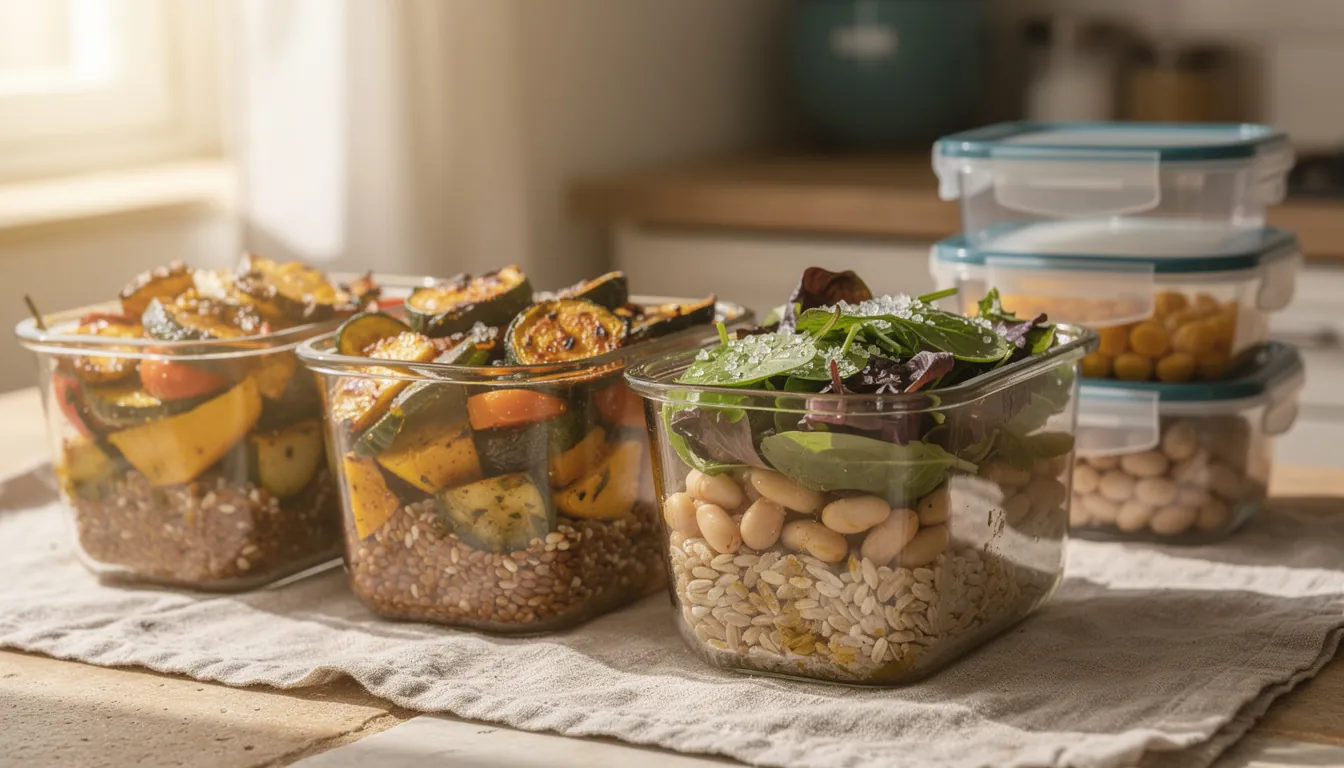
Store components separately in shallow containers rather than deep ones, so they cool quickly and you can see what you have without opening anything. A set of stacking glass boxes earns its shelf space here, mostly because glass does not hold onto garlic and you can read the contents through the side.
| Component | Plan for | Notes |
|---|---|---|
| Cooked grain | 3 days | Cool it fast and spread out; reheat with a splash of water |
| Braised legumes | 3 days | Keep them in their oil, it is the best part |
| Roast vegetables | 3 days | Fine cold; six minutes in a hot oven brings them back |
| Tomato sauce | 3 days | Freezes well in flat portions |
| Lemon-garlic dressing | 4 days | Separates in the fridge, shake it hard |
| Yogurt-tahini sauce | 2 days | Thickens as it sits, loosen with water |
| Pickled onion | 1 week | Keeps beyond that but softens |
| Washed leaves | 3 days | Kitchen paper in the box, lid resting rather than pressed down |
| Boiled eggs | 3 to 4 days | Keep them in the shell until you want one |
Those are cautious planning figures, not rules, and they are not authoritative food-safety advice. Guidance varies by country and by how cold your fridge actually runs, so use your own judgement and your own local food-safety guidance, and throw out anything that smells or looks wrong.
Four things do not survive prep and should be done at the plate. Dressed leaves collapse within an hour. Cut avocado browns however much lemon you put on it. Fried fish goes soft and scents the whole fridge. And anything crisp, including toasted nuts kept in a damp container, stops being crisp. Cook fish the night you eat it; a fillet takes eight minutes.
If you only have 45 minutes
Cut it to three things and accept a smaller week. Oven to 220°C / 425°F and one tray of vegetables in. Bulgur into boiling water for 12 minutes. One jar of lemon-garlic dressing. Drain a tin of chickpeas straight into a bowl with olive oil, lemon and salt, with no braising step. That is enough for four assembled dinners once you add a piece of fish, a boiled egg or a handful of feta on the night.
How to assemble in five minutes
Pick a base, a legume or other protein, two vegetables, a sauce, and one sharp or salty thing. Grain, chickpeas, roast peppers, rocket, yogurt-tahini, pickled onion. Or leaves instead of grain, tinned tuna instead of chickpeas, raw tomato and cucumber instead of roast peppers, lemon-garlic dressing, olives. A palm-sized piece of fish, a small handful of walnuts or a thumb-sized piece of feta finishes any of them.
Make one of those plates fish at least twice a week. Harvard's Nutrition Source and Oldways both put fish and seafood at least twice weekly, and Harvard also frames olive oil as the fat that replaces butter. Mayo Clinic's version of the pattern says fish two to three times a week, suggests one to two tablespoons of extra-virgin olive oil a day, and puts red meat at perhaps once a week or less. Tinned sardines and frozen white fish fillets both count, and neither needs planning.
Oldways recommends water as the drink to build the day around, and includes eating with other people in the pyramid rather than as an afterthought. Traditional Mediterranean eating often included wine with meals, authorities differ on whether and how much to recommend, and several advise people who do not drink not to start.
Three days of assembly from one prep session
Here is what the components above actually become, so the Sunday hour has something concrete on the other end of it. Nothing below is a recipe; every line is an assembly of things that already exist in the fridge.
Monday. Breakfast is yogurt with fruit and the nuts you toasted in a batch. Lunch is grain, chickpeas, roast vegetables and the lemon-garlic dressing in a box — dressed the night before, because grains and pulses improve sitting in dressing while leaves do not. Dinner is the fastest one of the week, while enthusiasm is still high: a tin of sardines on toast with lemon and parsley, or white fish roasted on top of the tomatoes, which needs twelve minutes and no attention.
Tuesday. Breakfast repeats, because deciding breakfast once is the point. Lunch is the same components in a different arrangement: leaves instead of grain, tinned tuna instead of chickpeas, olives and raw tomato instead of roast peppers. Dinner is the braised chickpeas warmed through with greens stirred in, bread alongside. This is the evening the prep session pays for itself.
Wednesday. The vegetables are past their best as a side, so they stop being one. Blitz or chop them into a rough sauce for pasta with a tin of beans and plenty of oil, or fold them into eggs. Lunch is whatever is left, over leaves, with the dressing and something salty.
Two things make that sequence hold. Put the fast meal on the night you are least likely to cook, not the night you have most time — the plan has to survive its worst evening, not its best. And keep one assembled thing at eye level in the fridge, because a container you can see is a container you eat from.
More arrangements of the same components are on the lunch ideas and dinner ideas pages, both of which are written to run off exactly this prep session.
Where to go next
If you want ideas rather than a system, start with Mediterranean diet breakfast ideas for mornings and Mediterranean diet snacks for the gap between lunch and dinner. Both are built to run off the components above. For a structured week, use the 7-day Mediterranean diet meal plan or the wider Mediterranean diet meal plan hub.
For what to buy, see the Mediterranean diet food list and the Mediterranean diet pantry staples page. If this is week one, Mediterranean diet for beginners covers the ground before any prep starts, and Mediterranean diet mistakes covers what tends to go wrong. Use the equipment table above for trays, storage and prep tools; the free kit supplies the printable plan and shopping list.
If you have a diagnosed condition, are pregnant, take regular medication or manage food allergies, read the medical disclaimer and speak to a qualified professional before changing how you eat.
Get the free 7-day plan and shopping list
Questions people ask
How long does Mediterranean meal prep actually take?
About two hours and twenty minutes for a full component prep, and roughly half of that is the oven working while you do something else. The shorter version in this guide takes about 45 minutes and still gets you a grain, a tray of vegetables and a dressing.
Do I need to cook beans from dried?
No. Tinned chickpeas, cannellini and butter beans are genuinely fine, and a 15-minute braise with olive oil, garlic and a strip of lemon peel makes them taste cooked rather than tinned. Dried beans are cheaper and have better texture if you already soak them overnight.
How many days will prepped components keep in the fridge?
Plan for three days for cooked grains, legumes and roast vegetables, and two days for anything with yogurt in it. Those are cautious planning figures rather than limits. Use your own judgement, follow your own local food-safety guidance, and throw out anything that smells or looks off.
Can I freeze any of it?
Cooked grains and a plain tomato sauce freeze well in flat portions. Roast vegetables go soft, dressed leaves are ruined, and yogurt sauces split. Freeze the sturdy things and make the fragile ones fresh.
What if I get bored eating the same thing all week?
That is the problem component prep solves. The same six components rearranged with different sauces, herbs and a change of protein do not read as the same meal twice, which is why this approach lasts longer than five identical boxes.
Everything in this section
- Mediterranean Air Fryer Meals: 8 Ideas for 2026
Eight Mediterranean air fryer meal ideas built around vegetables, beans, fish, chicken and grains, with practical prep notes and safe-food reminders.
- Mediterranean Diet Breakfast Ideas for Every Kind of Morning
Mediterranean breakfast ideas sorted by the time you have: no-cook bowls and toasts, make-ahead frittata and jars, and hot plates ready in ten minutes.
- Mediterranean Diet Dinner Ideas: 15 Easy Weeknight Meals
Easy Mediterranean dinner ideas built from five repeatable shapes — one pan, one tray, pasta, fish and a big salad — with the version of each that works on a Tuesday.
- Mediterranean Diet Lunch Ideas That Survive a Working Day
Mediterranean lunch ideas sorted by where you eat them: desk lunches that travel, five-minute lunches at home, and the leftover-into-lunch moves that need no recipe.
- Mediterranean Diet Snacks: Grab-and-Go to Make-a-Batch
Mediterranean diet snacks in three tiers: grab-and-go with nothing to make, five-minute plates, and batches like spiced chickpeas, tzatziki and dukkah.
- Mediterranean Slow Cooker Meals: 8 Ideas for 2026
Eight Mediterranean slow cooker meal ideas built around beans, lentils, vegetables, grains and poultry, with planning notes and safe-food reminders.
This page is general information about food and cooking, not medical or dietetic advice. Read the full disclaimer.