Mediterranean Diet Pantry Staples: The 20 to Buy First
As an Amazon Associate, this website earns from qualifying purchases.
The twenty Mediterranean diet pantry staples that make everything else easy, what each one is for, one thing to make with it, and the five to buy first.
On this page 5
This guide is part of What to eat, and how often.
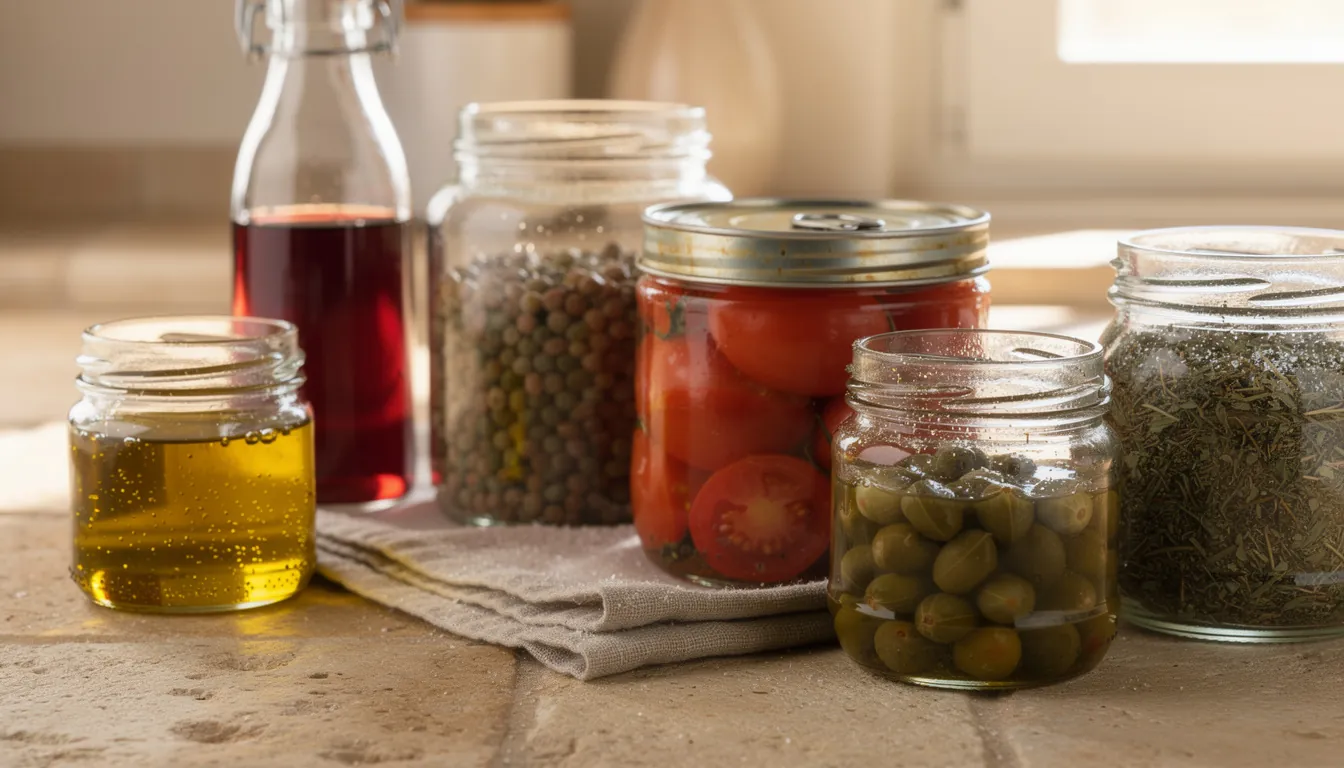
Mediterranean diet pantry staples are the roughly twenty shelf-stable things that turn whatever is fresh in the house into a meal without a recipe. Olive oil, vinegar, tinned tomatoes, tinned pulses, tinned fish, a couple of whole grains, and a small set of dried herbs and spices. Once they are in the cupboard, a bag of spinach and a lemon becomes dinner, and the weekly shop drops to produce, fish, dairy and bread.
The twenty, and what each is for
| Staple | What it is for | One thing to make | Product link |
|---|---|---|---|
| Extra-virgin olive oil | The everyday fat for dressing, roasting and finishing | Bread rubbed with garlic, tomato and oil | Olive oil on Amazon |
| Red wine vinegar | Sharpness in dressings, and to lift a heavy dish | Tomato, cucumber and red onion salad with oregano | Vinegar on Amazon |
| Tinned chopped tomatoes | The base of most sauces and braises | Chickpeas simmered in tomato with cumin | Tomatoes on Amazon |
| Tinned chickpeas | Ten-minute protein with body | Chickpeas roasted with smoked paprika until crisp | Chickpeas on Amazon |
| Tinned white beans | Creamy bulk that thickens whatever it joins | White beans crushed into wilted spinach and lemon | White beans on Amazon |
| Dried lentils | The cheapest filling thing on the shelf | Brown lentils with bay, garlic and olive oil | Lentils on Amazon |
| Tinned sardines in olive oil | The fastest route to fish twice a week | Sardines on toast with lemon and parsley | Sardines on Amazon |
| Tinned tuna | Salads and pasta with no cooking | Tuna, white beans, red onion and olive oil | Tuna on Amazon |
| Olives | Salt and depth in one ingredient | Olives, tomato and feta stirred through warm pasta | Olives on Amazon |
| Capers | A sharp note that wakes up bland dishes | Caper, lemon and parsley dressing over white fish | Capers on Amazon |
| Tahini | Sauce in thirty seconds, no cooking | Tahini loosened with lemon and water over roast veg | Tahini on Amazon |
| Bulgur | A quick grain that cooks off the heat | Bulgur with tomato, parsley, mint and lemon | Bulgur on Amazon |
| Farro | A chewy grain that holds up in salads | Farro with roast peppers and a vinegar dressing | Farro on Amazon |
| Brown rice | The steady base under stews and greens | Rice with lentils and slow-browned onions | Brown rice on Amazon |
| Wholewheat pasta | The weeknight fallback | Pasta with garlic, chilli, olive oil and greens | Pasta on Amazon |
| Rolled oats | Breakfast that needs no decisions | Oats with yogurt, walnuts and chopped fruit | Oats on Amazon |
| Almonds and walnuts | Crunch on top, and something to eat between meals | Walnuts scattered over yogurt and honey | Almonds / walnuts on Amazon |
| Sesame and pumpkin seeds | Texture on salads and grain bowls | Seeds toasted and tossed through a farro salad | Sesame / pumpkin seeds on Amazon |
| Dried oregano | The single most Mediterranean-tasting thing in the cupboard | Oregano, oil and vinegar over sliced tomatoes | Oregano on Amazon |
| Cumin, smoked paprika and bay | Warmth, smoke and background depth | Lentils with bay, finished with cumin and paprika | Cumin / paprika / bay leaves on Amazon |
Two fresh items belong on this list even though they are not shelf-stable in the strict sense, because everything above leans on them: garlic and lemons. A jar of honey rounds it out, mainly for yogurt and for balancing a sharp dressing.
If you are only buying five things
Start here. These five cover most weeknight cooking on their own.
- Extra-virgin olive oil. Everything else is optional if this is missing. It dresses, roasts, finishes and, in the Harvard Nutrition Source's description of the pattern, replaces butter and margarine outright.
- Tinned chopped tomatoes. Two tins is a sauce, a braise, or a pan of chickpeas simmered with cumin.
- Tinned chickpeas. Roast them, crush them into a salad, or drop them into the tomatoes above.
- Tinned sardines in olive oil. The reason twice-a-week fish is realistic on a Tuesday.
- Dried oregano. Oil, vinegar, oregano and a tomato is a dish in most of the Mediterranean and takes two minutes.
Add red wine vinegar, dried lentils and a bag of bulgur on the next shop and you are most of the way there. Buying a ready-made starter pantry set is a reasonable shortcut if you would rather stock the shelf in one go than assemble it over a month, and the jars, tins and basic tools worth owning are listed on the kit page.
Buying notes that actually matter
Olive oil. Buy extra-virgin, in a dark glass bottle or a tin, with a legible harvest or best-before date. Keep it in a cupboard, not next to the hob, because heat and light are what dull it. Buy a size you will finish in a couple of months rather than the biggest bottle in the shop. The Mayo Clinic Diet's guidance is one to two tablespoons a day, and that is Mayo's figure — a useful way to judge whether your bottle is moving at a sensible rate. If you want a step up from supermarket own-brand, a single-estate extra-virgin olive oil is the one upgrade in this whole list that changes how food tastes every single day.
Tinned fish. Sardines in olive oil rather than in brine or sunflower oil, if the choice is there. Anchovies are worth a jar even if you think you dislike them, because two of them melted into hot oil at the start of a dish disappear and leave savouriness behind.
Grains. Two is enough. One fast one, which is bulgur, and one chewy one, which is farro or barley. Brown rice and wholewheat pasta cover the rest. Buying six grains you never cook is how a cupboard becomes a museum.
Spices. Whole spices last longer, but ground ones get used. Buy small jars of cumin and smoked paprika and replace them when they stop smelling of anything, rather than buying large jars that go quiet in the back of the shelf.
Pulses. Keep both dried and tinned. Dried lentils and beans are dramatically cheaper and taste better; tinned ones are what make a ten-minute dinner possible. More on stretching this shelf in Mediterranean eating on a budget.
Storing it so you actually use it
A staple you cannot see does not exist. Decant oats, lentils, bulgur, farro, rice and nuts into clear jars or tubs, label anything that needs a cooking time, and keep them at eye level. Nuts and seeds keep better in the fridge or freezer once opened, because their oils fade at room temperature. Olive oil goes in a dark cupboard. Garlic and onions go somewhere cool and dry, never the fridge.
Group the shelf by job rather than by food type: oils and vinegars together, tins together, grains and pulses together, spices in one place. It sounds fussy until the first weeknight where you find everything for a meal in three reaches.
How the pantry fits the wider pattern
These staples map straight onto the frequency tiers. Whole grains, pulses, nuts, seeds, olive oil, herbs and spices are the base tier that Oldways describes as being eaten at every meal. Tinned sardines and tuna are what make the "often, at least twice weekly" fish tier achievable. Nothing here is in the less-often tier at all, which is a good sign about where your shopping money is going.
For the full tier breakdown, see our Mediterranean diet food list. To turn the pantry into an actual shopping trip, use the shopping section of the food and grocery list, which splits the one-off starter shop from the weekly rebuy. For the habits that quietly undo all of this — mainly portion drift on cheese and oil — read foods to limit. If you are cooking for the week in one go, meal prep is the next stop.
If you have a food allergy, a diagnosed condition, are pregnant, or take medication that interacts with food, talk to a qualified professional before changing how you eat. Our medical disclaimer explains what this site is.
Get the free 7-day plan and shopping list
Questions people ask
What are the essential Mediterranean pantry staples?
Extra-virgin olive oil, red wine vinegar, tinned tomatoes, tinned chickpeas and white beans, dried lentils, tinned sardines and tuna, olives, capers, tahini, a couple of whole grains, oats, nuts and seeds, dried oregano, cumin, smoked paprika, bay leaves, garlic, lemons and honey.
How long do these staples keep?
Tins and jars keep for a year or more, dried pulses and grains for months, and ground spices hold their flavour for roughly six months to a year. Olive oil is the one to use rather than save, since it fades once open.
Which olive oil should I buy?
Extra-virgin, in a dark bottle or tin, with a harvest or best-before date you can read. The Mayo Clinic Diet suggests one to two tablespoons a day, which means a bottle should be emptying steadily rather than sitting for a year.
Do I need all twenty at once?
No. Five items cover most weeknight cooking: olive oil, tinned tomatoes, tinned chickpeas, tinned sardines and dried oregano. The rest can arrive one or two per shop.
Is dried better than tinned for beans?
They do different jobs. Dried lentils and beans cost far less and taste better cooked from scratch. Tinned beans are what make dinner possible in ten minutes. Most kitchens want both.
Keep going
- Mediterranean Diet Food List and Grocery List: What to Eat, How Often, and What to Buy
The Mediterranean diet food list organised by how often you eat each group — then the same thing as a shopping list, split into a starter shop and a short weekly one.
- Mediterranean Diet Food List and Grocery List: What to Eat, How Often, and What to Buy
The Mediterranean diet food list organised by how often you eat each group — then the same thing as a shopping list, split into a starter shop and a short weekly one.
- Mediterranean Diet on a Budget: Tinned, Dried and Frozen
How to eat a Mediterranean pattern on a tight budget using tinned fish, dried legumes, frozen vegetables and bulk grains, with a swap table and a cheap week.
This page is general information about food and cooking, not medical or dietetic advice. Read the full disclaimer.