Build meals on plants
Fruit, vegetables, whole grains, beans and nuts at most meals.
Evidence summary
What Mediterranean-style eating is, what the American Diabetes Association's 2026 Standards of Care say about it, and what the main trials found, with each figure linked to its source.
Reviewed October 10, 2026
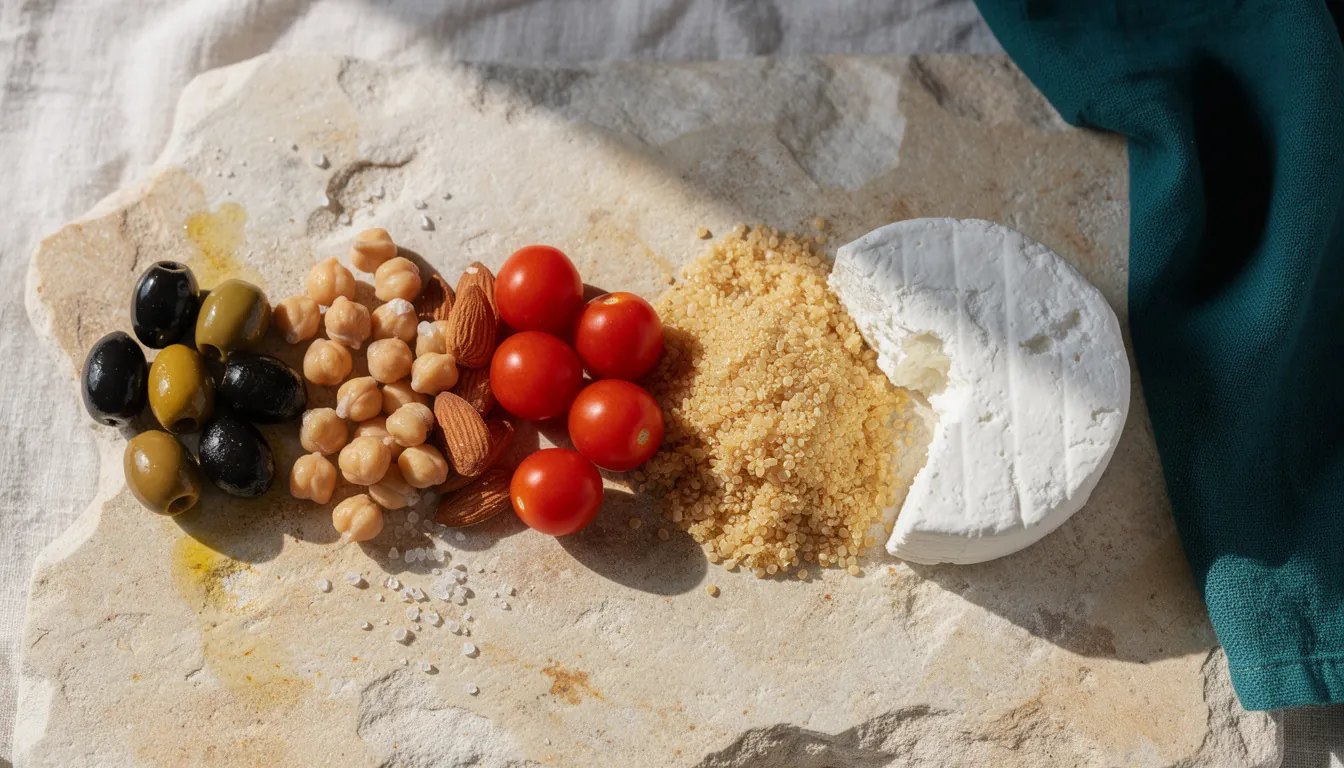
The short version: the American Diabetes Association's 2026 Standards of Care list Mediterranean-style eating among several suitable eating patterns for people with diabetes and recommend that clinicians counsel people to consider it. ADA also says no single pattern is required: the shared features of healthy patterns matter more than the label.
It describes the traditional eating habits of the countries around the Mediterranean Sea. More than 20 countries border it, and their food differs by culture, religion and what each region grows, so there is no single Mediterranean menu. ADA's 2026 Standards describe the features these eating styles share:
Fruit, vegetables, whole grains, beans and nuts at most meals.
Extra-virgin olive oil in place of butter and most other fats.
Dairy and red meat in smaller amounts; fish, eggs and poultry in low to moderate amounts.
Sweets, added sugars, sugary drinks, salt and highly processed foods kept to a minimum.
For how four food organizations put numbers on the same pattern (fish twice a week, red meat less often, and so on), see our side-by-side comparison of four Mediterranean guides. The numbers differ between publishers, so each one is attributed there.
The Standards of Care are ADA's yearly clinical guidance for diabetes care, published each January in Diabetes Care. Three points from the 2026 edition bear on this topic:
ADA also says that, until the evidence on specific patterns is stronger, clinicians should focus on what healthy patterns have in common: nonstarchy vegetables, whole fruit, legumes, whole grains, nuts, seeds and low-fat dairy or nondairy alternatives, with less red meat, sugar-sweetened drinks, sweets, refined grains and processed or ultraprocessed foods. On alcohol, ADA advises people who drink to stay within recommended limits and people who do not drink not to start.
These four randomized trials tested Mediterranean-style eating in people with or at risk of type 2 diabetes; ADA's 2026 text cites the PREDIMED trial and Keto-Med. The figures come from each study's published abstract. They describe groups of trial participants, not what any one person can expect.
| Study | Who took part | What was compared | What it reported | Limits |
|---|---|---|---|---|
| Esposito et al., 2009 (Naples, Italy) | 215 overweight adults with newly diagnosed type 2 diabetes, not yet on glucose-lowering drugs | Lower-carbohydrate Mediterranean-style diet (under 50% of calories from carbohydrate) vs. a low-fat diet | After 4 years, 44% of the Mediterranean group and 70% of the low-fat group had started glucose-lowering medication under the trial's A1C rule. | Single center; the doctors who started medication knew each person's diet group; food intake was self-reported. |
| Esposito et al., 2014 follow-up | The same 215 participants, followed for up to 8.1 years | Same two diets | Median time before medication was needed: 4.8 years on the Mediterranean diet vs. 2.8 years on the low-fat diet. Partial or complete remission was more common in the Mediterranean group in year 1 (14.7% vs. 4.1%). | Same trial and limits as above; a longer follow-up, not a new study. |
| PREDIMED diabetes subgroup (Salas-Salvadó et al., 2014, Spain) | 3,541 adults aged 55 to 80 without diabetes but at high cardiovascular risk | Mediterranean diet plus extra-virgin olive oil, Mediterranean diet plus nuts, or advice on a low-fat diet; no calorie target | New cases of type 2 diabetes per 1,000 person-years: 16.0 (olive oil group), 18.7 (nuts group), 23.6 (low-fat advice) over a median 4.1 years. Only the olive-oil group's difference was statistically clear. | A secondary outcome of a heart trial; more people withdrew from the control group; the journal published a correction in 2018, the year the PREDIMED investigators reported irregularities in how some participants were randomized. |
| Keto-Med crossover trial (Gardner et al., 2022, Stanford) | 40 adults with prediabetes or type 2 diabetes (33 with complete data) | 12 weeks of a ketogenic diet and 12 weeks of a lower-carbohydrate Mediterranean diet, in random order | A1C did not differ between the two diets at 12 weeks; ADA notes LDL cholesterol rose on the ketogenic diet. | Small and short; both diets cut added sugar and refined grains, so it compares two low-carbohydrate approaches. |
Most of the remaining evidence on Mediterranean eating comes from observational studies, which show associations rather than cause and effect.
Mediterranean meals often include bread, pasta, rice, potatoes and fruit. Both the original CDC feature and ADA's guidance point to the type and amount of carbohydrate as the thing to plan around:
How much carbohydrate suits a person depends on their medicines, glucose targets and preferences. ADA says the balance of carbohydrate, protein and fat should be individualized, and that is a conversation for a doctor, a registered dietitian or a diabetes care and education specialist. Our Mediterranean food list and weekly meal pattern planner can help turn whatever plan you agree into a shopping list and a week of meals.
CDC's feature "Healthy Eating for People With Diabetes" (cdc.gov/diabetes/library/features/mediterranean-style-eating.html, last reviewed December 6, 2022) now returns a "page not found" error. Hundreds of health articles still link to it. This page covers the same ground: what Mediterranean-style eating is, how it relates to diabetes, and how to choose a plan. It uses current sources, mainly ADA's 2026 Standards and the trials listed above. The archived copy of CDC's original is linked in the sources.
The CDC feature cited a 2019 ADA consumer summary. ADA's current guidance is the 2026 Standards, which include a Mediterranean-specific recommendation (5.30) and a prediabetes recommendation (3.4). We have left out one line from the old page, a statement about inflammation, because we could not find it supported in the current guidance we reviewed.
Method: statements are quoted or closely condensed from the linked sources as read on October 10, 2026. No figures were calculated or combined. If a source changes or a summary here is inaccurate, use the contact form and include the section and source.
For the site's broader editorial process, see how we research.
This resource is general information about food and cooking, not medical or dietetic advice. Read the full disclaimer.